
Key Thesis
Traditional MQL frameworks are broken. The companies winning in B2B are building go-to-market motions around real-time buying signals, not arbitrary form fills.
The Problem with MQL-Based GTM
For the past decade, B2B marketing has operated on a simple premise: capture leads, score them, hand them to sales. The marketing qualified lead (MQL) became the universal currency of marketing performance. Fill out a form, download a whitepaper, attend a webinar - congratulations, you're an MQL.
There's just one problem: most MQLs don't buy.
According to 6sense's 2024 Buyer Experience Report, which surveyed 2,509 B2B buyers, approximately 70 percent of the B2B buying journey is complete before a buyer even fills out a form or contacts sales. By the time someone raises their hand, they've already done their research, evaluated competitors, and often formed preferences. Your MQL process is catching buyers at the end of their journey, not the beginning.
The result? Marketing teams celebrate lead volume while sales teams complain about lead quality. Pipeline becomes unpredictable. Forecasting becomes guesswork. And the fundamental question - "Are we reaching buyers before they're ready to buy?" - goes unanswered.
What Are Buying Signals?
Buying signals are behavioral indicators that suggest an account is actively evaluating solutions in your category. Unlike form fills, which are explicit but rare, buying signals are implicit but abundant.
Common buying signals include:
- Content consumption patterns: Repeated visits to pricing pages, case studies, or comparison content
- Technographic changes: New technology implementations that create integration needs
- Firmographic triggers: Funding rounds, leadership changes, expansion announcements
- Engagement velocity: Accelerating interaction across multiple channels
- Intent data: Third-party signals showing research activity on relevant topics
The key insight: these signals exist whether or not the buyer fills out a form. They're happening right now, across your target accounts, whether you're tracking them or not.
A Framework for Signal Scoring
Not all signals are created equal. A CEO visiting your pricing page is a different signal than an intern downloading a whitepaper. The challenge is building a scoring model that reflects buying propensity, not just activity volume.
Here's a framework I've used across multiple B2B implementations:
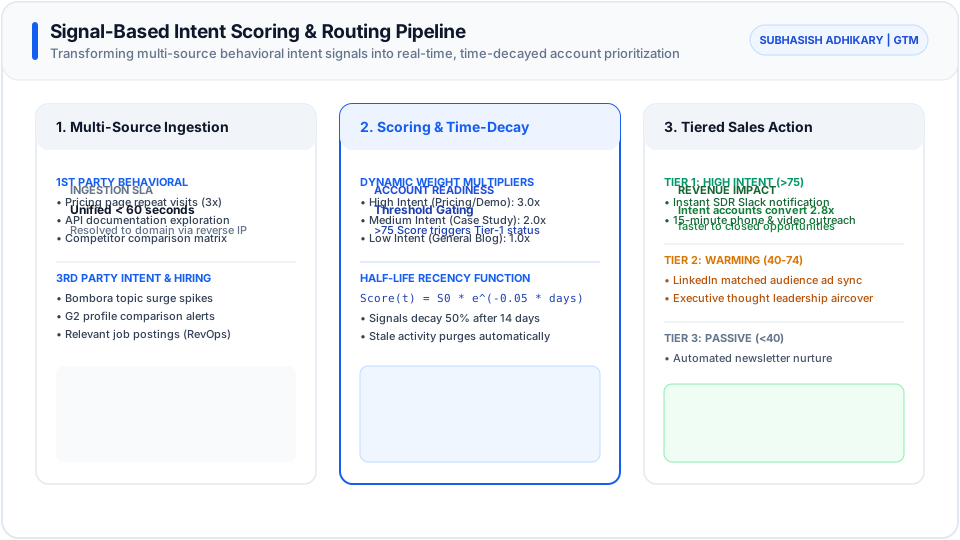
Signal Categories:
- High-intent signals (3x multiplier): Pricing page visits, demo requests, competitor comparison content, integration documentation
- Medium-intent signals (2x multiplier): Case study downloads, webinar attendance, product tour completions
- Low-intent signals (1x multiplier): Blog reads, newsletter signups, social engagement
Signal Velocity:
Signals compound over time. An account that generates 10 signals in a week is more interesting than an account that generates 10 signals over six months. Build velocity scoring that decays signal weight over time.
Signal Diversity:
Multiple signal types from the same account indicate broader organizational interest. An account with signals from marketing, IT, and finance stakeholders is further along than an account with signals from a single department.
Implementation: From Signals to Action
Collecting signals is table stakes. The real work is building workflows that convert signals into action. Here's what that looks like in practice:
Step 1: Define your signal universe. Map every data source that could indicate buying intent. This typically includes your website analytics, marketing automation platform, CRM, intent data providers (6sense, Demandbase, Bombora), and product usage data if you have a freemium model.
Step 2: Build signal aggregation. Use a customer data platform (CDP) or integration layer like Segment to collect signals from all sources into a unified account view. Every signal should be tied to an account, not just a contact.
Step 3: Create signal scoring rules. Work with sales to define what signals matter most. This isn't a marketing-only exercise. Sales needs to validate that the signals you're prioritizing actually correlate with buying behavior.
Step 4: Design signal-triggered workflows. When an account crosses a signal threshold, what happens? Typical workflows include: alerting sales with context, triggering personalized nurture sequences, launching targeted ad campaigns, or scheduling executive outreach.
Step 5: Measure and iterate. Track signal-to-conversion rates by signal type. Double down on signals that predict pipeline. Deprioritize signals that don't.
Measuring Signal-Based GTM
The metrics shift when you move from MQL-based to signal-based GTM. Instead of measuring lead volume, you measure:
- Signal coverage: What percentage of your target accounts are generating signals?
- Signal velocity: How quickly are accounts moving through signal thresholds?
- Signal-to-pipeline conversion: What percentage of signal-qualified accounts become opportunities?
- Signal-influenced revenue: How much pipeline and revenue can be traced back to signal engagement?
According to a 2024 B2B buying study from The Starr Conspiracy, intent-prioritized accounts converted to closed opportunity at 21.3%, versus 8.4% for accounts not prioritized by intent. That's a 2.5x improvement in conversion rates - not from better sales execution, but from better signal identification.
Limitations and Trade-offs
Signal-based GTM isn't a panacea. There are real limitations to acknowledge:
Signal noise: According to publisher data analyzed by The Growth Syndicate, 25% of intent surges lead to no buying activity. Not every signal indicates genuine purchase intent. Some are research, some are competitive intelligence, some are just curiosity.
Implementation complexity: Building a signal-based GTM motion requires integration across multiple systems, alignment between marketing and sales, and ongoing maintenance. This isn't a set-it-and-forget-it initiative.
Data quality: Signal scoring is only as good as the underlying data. If your CRM data is stale, your intent data is incomplete, or your website tracking is broken, your signal model will produce garbage.
Organizational change: Moving from MQL-based to signal-based GTM requires fundamental changes to how marketing and sales work together. Marketing can no longer optimize for lead volume. Sales can no longer complain about lead quality without engaging in signal definition.