
Key Thesis
Most B2B companies optimize for lead generation but neglect the critical handoff and conversion stages. The real leverage is in what happens after the MQL.
The MQL Handoff Problem
Marketing spends thousands of dollars generating leads. Sales complains the leads are garbage. The leads sit in the CRM, untouched, growing cold. Sound familiar?
The MQL handoff is where most B2B go-to-market motions break down. Marketing optimizes for lead volume. Sales optimizes for closed deals. But the critical middle ground - what happens between marketing qualification and sales engagement - gets neglected.
According to MarketingSherpa research, only 27% of MQLs are followed up by sales within 24 hours. Meanwhile, InsideSales.com found that lead response time under 5 minutes increases conversion by 9x. The gap between these two data points represents massive pipeline leakage.
The problem isn't just speed. It's context. When sales receives an MQL, they typically see a name, email, company, and maybe a form submission. They don't see the content the prospect consumed, the pages they visited, the signals that triggered the MQL status. Sales has to start from scratch, asking questions marketing already has answers to.
A Post-MQL Framework
The post-MQL stage requires its own strategy, not just a handoff process. Here's a framework for thinking about what happens after marketing qualification:
Stage 1: Immediate Response (0-24 hours)
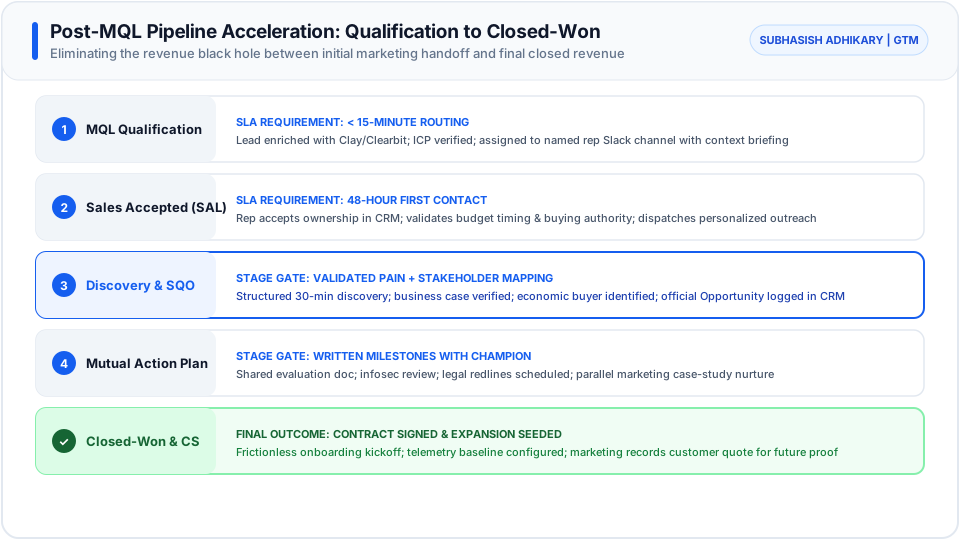
The goal here is speed and context. When an MQL is generated, sales should receive an alert with full context: what content did they consume? What pages did they visit? What signals triggered the MQL? The first outreach should reference this context, not ask basic questions.
Stage 2: Discovery and Qualification (Days 1-7)
This is where sales validates the opportunity. But "validation" doesn't mean starting from zero. It means building on the context marketing has already gathered. The discovery call should confirm what marketing suspects, not discover it from scratch.
Stage 3: Nurture and Engagement (Weeks 1-12)
Not every MQL is ready to buy immediately. According to LinkedIn's 2024 B2B Buyer Report, only 3-5% of buyers are actively purchasing at any given time. The other 95% are in research mode. Your post-MQL motion needs to handle both: immediate opportunities and long-term nurture.
Stage 4: Conversion and Handoff to Customer Success (Months 3+)
When the opportunity converts, there's another handoff - this time to customer success. The context gathered during the sales process should transfer seamlessly, so customer success isn't starting from zero either.
Sales-Marketing Alignment in Practice
Alignment isn't a monthly meeting. It's shared metrics, shared context, and shared accountability.
Shared Metrics: Marketing and sales should review the same dashboard. Not separate reports - the same report. Pipeline generated, pipeline velocity, conversion rates by stage, win rates by source. When both teams look at the same data, alignment happens naturally.
Shared Context: Every MQL should come with context. What did they download? What pages did they visit? What signals triggered the MQL? This context should live in the CRM, accessible to sales before they make the first call.
Shared Accountability: Marketing shouldn't be measured on MQL volume. Sales shouldn't be measured on closed deals alone. Both should be measured on pipeline generated and pipeline converted. When incentives align, behavior aligns.
According to the Annuitas Group, companies with aligned sales and marketing achieve 36% higher customer retention. The correlation isn't accidental. Alignment throughout the buyer journey - not just at the handoff - creates better customer experiences.
Nurture Beyond the Handoff
The average B2B sales cycle is 84 days, according to Gartner's 2024 B2B Buying Report. That's nearly three months from first touch to close. Most marketing nurture programs end at the MQL. That's a mistake.
Post-MQL nurture should continue throughout the sales cycle, coordinated between marketing and sales. Marketing provides educational content, case studies, and thought leadership. Sales provides personalized outreach, demos, and proposals. Both should be working in concert, not in silos.
The key is sequencing. Don't send a case study the same day sales sends a proposal. Coordinate the cadence so marketing and sales are reinforcing each other, not competing for attention.
Measuring Post-MQL Performance
The metrics that matter post-MQL are different from pre-MQL metrics. Instead of measuring lead volume, measure:
- MQL-to-SQL conversion rate: What percentage of MQLs become sales-qualified opportunities?
- Lead response time: How quickly does sales engage with new MQLs?
- Sales cycle length: How long does it take from MQL to close?
- Win rate by source: Which MQL sources produce the highest win rates?
- Pipeline velocity: How quickly do MQLs move through the pipeline?
These metrics reveal where your post-MQL motion is breaking down. If MQL-to-SQL conversion is low, your qualification criteria may be too loose. If lead response time is slow, you need better alerting. If sales cycle length is increasing, your nurture may be insufficient.