
Key Thesis
The era of growth-at-all-costs is over. The winning B2B companies are building efficient GTM motions that maximize revenue per dollar spent.
The Efficiency Imperative
From 2010 to 2021, B2B SaaS operated in a zero-interest-rate environment. Capital was cheap. Growth was the only metric that mattered. Customer acquisition cost (CAC) could be whatever it took to hit the next growth milestone.
That era is over. According to Bessemer Venture Partners, average B2B CAC increased 32% from 2021 to 2024. Meanwhile, growth rates have slowed. The result: companies that optimized for growth are now optimizing for efficiency.
But efficiency is not just about cutting costs. It is about maximizing revenue per dollar spent across the entire go-to-market motion. The most efficient B2B companies are not spending less - they are spending smarter.
Measuring GTM Efficiency
The primary metric for GTM efficiency is the Magic Number (for public companies) or the CAC Payback Period (for private companies). Both measure how efficiently you convert GTM spend into revenue.
Magic Number: Quarterly net new ARR divided by previous quarter GTM spend. A Magic Number above 0.75 indicates efficient growth. Below 0.5 indicates inefficiency.
CAC Payback Period: Total CAC divided by monthly gross margin per customer. Top-quartile SaaS companies achieve payback in under 12 months. Median is 18 months. Below-quartile extends beyond 24 months.
Marketing Efficiency Ratio (MER): Total revenue divided by total marketing spend. A MER below 3x indicates unsustainable spend. Top performers achieve 5x or higher.
Rule of 40: Revenue growth rate plus profit margin should exceed 40%. Companies achieving Rule of 40 are considered efficient growers.
An Efficiency Framework
Efficiency is not a single tactic. It is a framework that applies across the entire GTM motion. Here are the four pillars:
1. Channel Efficiency: Not all channels are created equal. Some produce pipeline at $50 CAC. Others require $5,000. The efficient GTM motion allocates budget to the most efficient channels, not the most familiar ones.
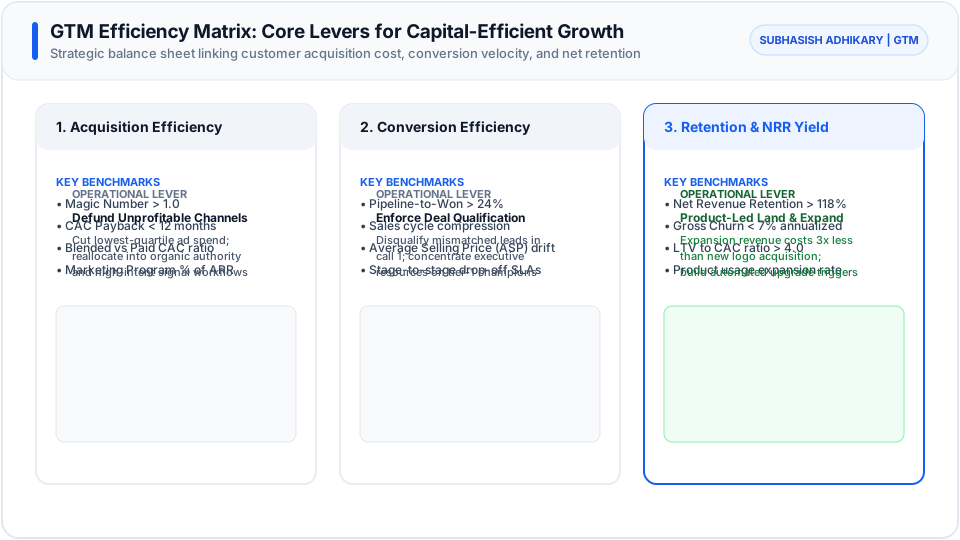
2. Conversion Efficiency: Every stage of the funnel leaks. The efficient GTM motion identifies the biggest leaks and fixes them. A 10% improvement in MQL-to-SQL conversion can be worth more than a 50% increase in lead volume.
3. Velocity Efficiency: Time is money. The efficient GTM motion shortens sales cycles through better qualification, better content, and better processes. Every day saved in the sales cycle is a day of revenue.
4. Retention Efficiency: Acquiring a new customer costs 5-25x more than retaining an existing one (Bain & Company). The efficient GTM motion invests in retention and expansion, not just acquisition.
Efficiency Tactics That Work
Focus on net revenue retention. Companies with net revenue retention above 120% grow efficiently because existing customers fund growth. Invest in customer success, expansion, and upsell before investing in new acquisition.
Eliminate low-converting channels. Audit every channel quarterly. Kill channels with CAC payback beyond 18 months. Double down on channels with payback under 12 months.
Improve sales productivity. The average B2B sales rep spends only 37% of time selling (CSO Insights). The rest is admin, research, and internal meetings. Tools that automate admin and provide better context increase selling time.
Invest in content that compounds. Paid ads stop working when you stop paying. Content continues generating traffic and leads for years. The efficient GTM motion invests in content that compounds over time.
Automate repetitive tasks. Marketing operations, sales operations, and customer success all have repetitive tasks that can be automated. Every hour automated is an hour of human capacity freed for higher-value work.
Trade-offs and Limitations
Efficiency is not without trade-offs. The most efficient GTM motion may not be the fastest. Companies that optimize purely for efficiency may miss growth opportunities.
The balance is context-dependent. Early-stage companies should optimize for growth. Growth-stage companies should optimize for efficiency. Enterprise companies should optimize for both.
The key insight: efficiency is not about spending less. It is about spending smarter. The most efficient companies are not cutting budgets - they are reallocating them to higher-return activities.