
Key Thesis
Most B2B companies run channels in silos. The winners integrate channels into a coherent motion where each channel amplifies the others.
The Channel Silo Problem
Most B2B marketing organizations are structured by channel. There is a paid media team, a content team, an events team, an outbound team, and a social team. Each has its own budget, its own metrics, and its own goals.
The problem: buyers do not experience your marketing by channel. They experience it as a unified (or disjointed) whole. A buyer might see your LinkedIn ad, read your blog post, attend your webinar, and then get a cold email. If these channels are not coordinated, the experience is fragmented.
According to Gartner 2024 research, B2B buyers use an average of 11.4 channels to gather information during the buying process. They are not channel-loyal. They are seeking information wherever they can find it. Your job is to meet them across those channels with a coherent message.
The Buyer Reality
Consider a typical B2B buyer journey:
Week 1: The buyer searches Google for solutions to their problem. They find your blog post through SEO. They read it and subscribe to your newsletter.
Week 2: They see your LinkedIn ad retargeting blog readers. They click through to a case study. They download it.
Week 3: They receive a nurture email with a webinar invitation. They register and attend.
Week 4: They visit your pricing page. Your intent data flags this as a high-intent signal. Sales reaches out with a personalized message referencing the webinar.
Week 5: They take a demo. The sales rep references the case study they downloaded and the webinar they attended.
Week 8: They close as a customer.
This is an integrated journey. Every touchpoint builds on the last. The message is coherent. The context transfers between channels.
Now consider the siloed version: the buyer reads the blog post but never sees the LinkedIn ad because retargeting is managed separately. They attend the webinar but sales does not know because webinar data is not in the CRM. The experience is fragmented, and the buyer has to start from scratch with each channel.
An Integration Framework
Channel integration requires three foundations:
1. Shared Data: Every channel should feed into a unified data layer. Website visits, ad clicks, email opens, webinar attendance, sales calls - all should be visible in a single customer view. Without shared data, integration is impossible.
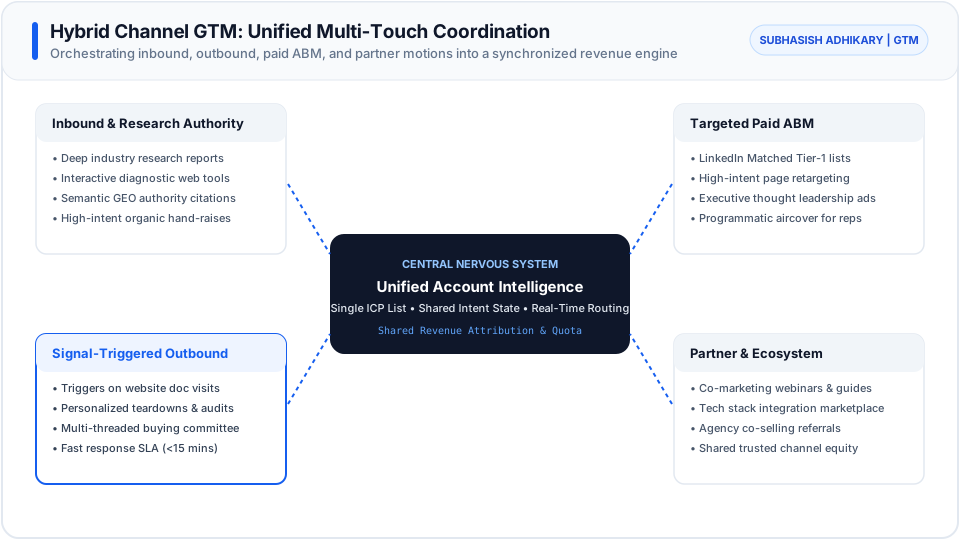
2. Shared Metrics: Channels should not be measured in isolation. Instead of measuring cost per lead by channel, measure pipeline generated by integrated campaign. Instead of measuring webinar attendance, measure webinar-to-pipeline conversion.
3. Shared Accountability: Channel teams should not optimize for channel-specific metrics. Instead, they should optimize for contribution to integrated pipeline. This requires organizational change, not just technical integration.
Implementation in Practice
Here is what channel integration looks like in practice:
Campaign Planning: Instead of planning campaigns by channel, plan by audience and stage. Define the audience, define the message, define the desired outcome. Then select the channels that will deliver that message to that audience most effectively.
Content Orchestration: Create content that works across channels. A single piece of research can become a blog post, a webinar, a LinkedIn post series, an email sequence, and a sales deck. The content is created once and orchestrated across channels.
Data Integration: Use a customer data platform (CDP) or integration layer to connect all channel data. Every touchpoint should update the unified customer view. Every channel should be able to access the full history.
Workflow Automation: Build workflows that trigger across channels. When a prospect attends a webinar, automatically send a follow-up email, notify sales, and add them to a retargeting audience. The workflow spans channels.
Measuring Integration
The metrics for integrated GTM are different from siloed GTM:
- Pipeline by integrated campaign: Not pipeline by channel, but pipeline by campaign that spans channels.
- Multi-touch attribution: Not single-touch attribution, but multi-touch that credits all contributing channels.
- Channel contribution: How much did each channel contribute to integrated pipeline?
- Cross-channel velocity: How quickly do prospects move through multi-channel journeys?
Companies with integrated GTM see 2x pipeline velocity compared to siloed approaches, according to Forrester 2024 research. The difference is not just better execution - it is better coherence.