
Key Thesis
Rules-based lead scoring is dead. AI-powered scoring models that learn from data outperform static rules by 3-5x in predictive accuracy.
The Limits of Rules-Based Scoring
For years, B2B marketing has relied on rules-based lead scoring. Assign points for job title, company size, content downloads, and website visits. When a lead crosses a threshold, it becomes an MQL.
The problem: rules-based scoring is static. It does not learn from outcomes. It does not adapt to changing buyer behavior. It does not account for the complex interactions between variables that predict buying.
According to Forrester research, AI-powered lead scoring models outperform rules-based models by 3-5x in predictive accuracy. The difference is not marginal - it is transformative.
The AI Approach to Lead Scoring
AI lead scoring uses machine learning to identify patterns in historical data that predict buying behavior. Instead of humans defining rules, the model learns from data which factors correlate with conversion.
The AI approach has several advantages:
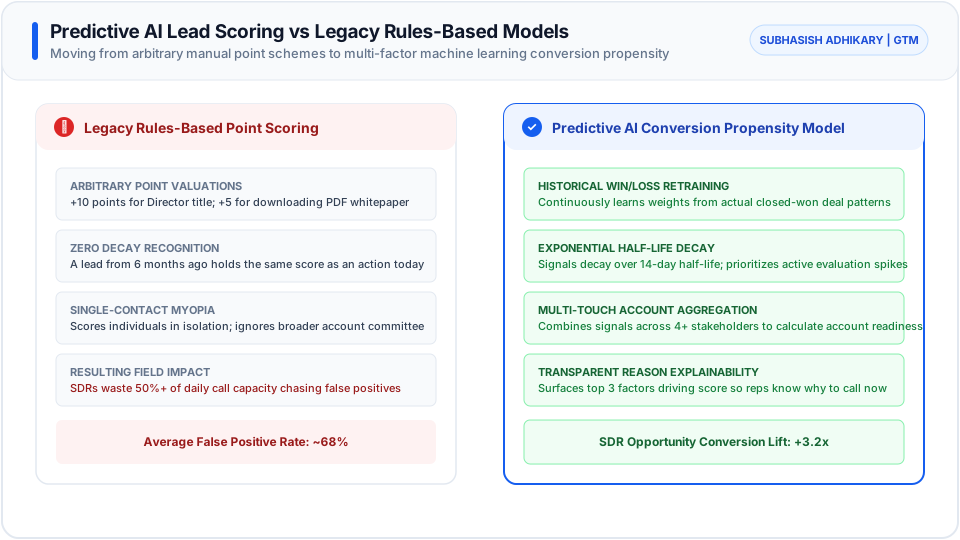
Handles complexity: AI models can process hundreds of variables and identify non-linear relationships that humans cannot detect. A rules-based model might score "VP title = 10 points." An AI model might learn that "VP title + visited pricing page + downloaded case study + company size 100-500 = high probability."
Continuous learning: AI models improve over time as they process more data. A rules-based model is static unless humans manually update it. According to Gartner, continuous learning models improve accuracy by 15-20% over the first year.
Handles scale: AI models can process 100x more data points than human-defined rules. They can analyze every website visit, every email open, every content download, and every sales interaction to build a comprehensive picture of buying intent.
Implementing AI Lead Scoring
Implementing AI lead scoring requires several foundations:
Data quality: AI models are only as good as the data they learn from. Ensure your CRM data is clean, your tracking is comprehensive, and your historical data is accurate.
Outcome definition: Define what "good" looks like. Which leads converted? Which did not? The model needs clear labels to learn from.
Feature engineering: Identify the data points that might predict conversion. This includes firmographics, behavioral data, engagement data, and intent signals.
Model training: Train the model on historical data. Validate it on holdout data. Iterate based on performance.
Deployment and monitoring: Deploy the model in production. Monitor its predictions. Compare them to actual outcomes. Retrain periodically.
Measuring and Improving
Measure AI lead scoring by:
- Predictive accuracy: What percentage of high-scored leads convert vs low-scored leads?
- Conversion rate lift: How much does AI scoring improve conversion rates vs rules-based?
- Sales productivity: Are sales reps more productive when working AI-scored leads?
- Pipeline quality: Is pipeline from AI-scored leads higher quality?
According to Gartner, companies using AI scoring see 28% higher conversion rates. The improvement comes from better prioritization, not more leads.
Limitations and Considerations
AI lead scoring is not a panacea:
Data requirements: AI models need substantial historical data to learn from. If you have fewer than 1,000 conversions in your history, AI scoring may not outperform simple rules.
Interpretability: AI models can be black boxes. Sales teams may not trust scores they do not understand. Provide explainability features that show which factors contributed to each score.
Maintenance: AI models degrade over time as buyer behavior changes. Plan for regular retraining and monitoring.