
Key Thesis
AI is transforming advertising from campaign-based to always-on optimization. The winners are building AI-native advertising systems, not just using AI to write ad copy.
From Campaigns to Systems
Traditional advertising operates in campaigns. Launch, monitor, optimize, end. Repeat. The campaign model worked when optimization was manual and slow. In an AI-native world, it is obsolete.
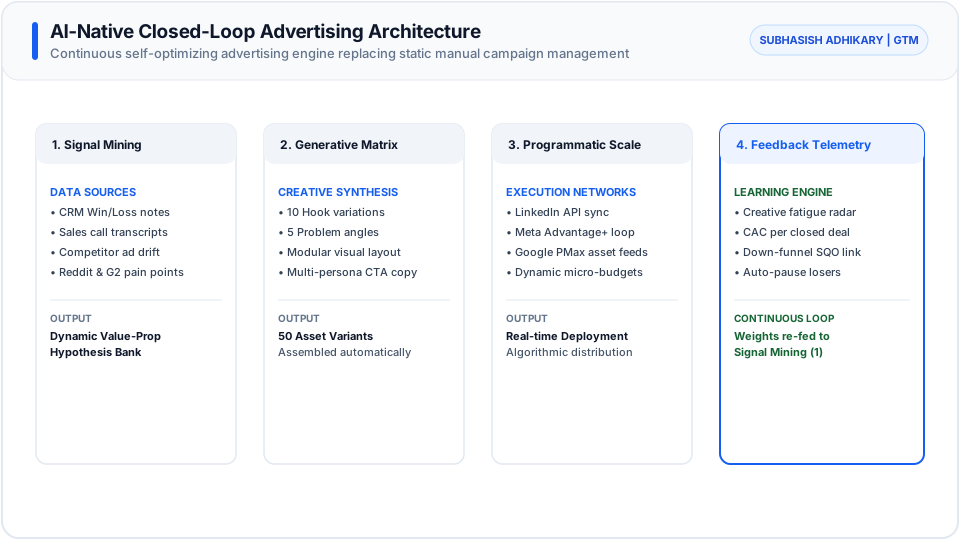
AI-native advertising operates as a system, not a series of campaigns. The system is always on, continuously optimizing across channels, audiences, and creatives. It does not wait for campaign boundaries - it optimizes in real-time.
According to Google research, AI-optimized ad campaigns see 35% better return on ad spend (ROAS) than manually optimized campaigns. The difference is not just better execution - it is fundamentally different approach.
AI Advertising Capabilities
AI transforms advertising across multiple dimensions:
Bidding Optimization: AI algorithms analyze millions of data points to determine optimal bid for each impression. They consider user intent, context, competition, and conversion probability. According to industry benchmarks, AI bidding improves conversion rates by 20-30% on average.
Audience Targeting: AI identifies high-value audience segments that humans might miss. It analyzes behavioral patterns, predicts conversion probability, and targets accordingly. AI can process far more signals than human media buyers.
Creative Optimization: AI tests and optimizes creative elements - headlines, images, calls-to-action, formats. Automated creative optimization can test 100x more variations than manual approaches. It identifies winning combinations and scales them.
Budget Allocation: AI allocates budget across channels, campaigns, and audiences based on real-time performance. It shifts budget to highest-performing elements automatically, maximizing overall ROI.
Cross-Channel Orchestration: AI coordinates advertising across multiple channels, ensuring consistent messaging and optimal channel mix. It understands how channels interact and optimizes the overall system, not just individual channels.
Building an AI-Native System
Building an AI-native advertising system requires several foundations:
Data Infrastructure: AI needs data. Ensure your advertising platforms are integrated with your CRM, marketing automation, and analytics. Every conversion, every touchpoint, every signal should flow back to the advertising system.
Clear Objectives: Define what the system should optimize for. Is it pipeline generation? Revenue? Customer acquisition cost? Clear objectives guide AI optimization.
Guardrails: Define boundaries for AI operation. What is the maximum budget per channel? What audiences are off-limits? What brand safety rules apply? Guardrails prevent costly mistakes.
Continuous Learning: AI systems improve over time. Ensure your system is learning from outcomes, not just executing. Feed conversion data back to the system. Let it learn what works.
AI Creative Optimization
Creative is where AI advertising creates particular value. Traditional creative development is slow and limited. AI enables rapid testing and optimization at scale.
Dynamic Creative: AI generates creative variations dynamically based on audience, context, and performance data. It combines headlines, images, and calls-to-action in thousands of combinations to find winners.
Predictive Creative: AI predicts which creative elements will perform before they are even launched. It analyzes historical performance data to identify patterns that predict success.
Continuous Optimization: AI continuously tests and optimizes creative. It does not wait for campaign boundaries. It identifies underperforming elements and replaces them in real-time.
According to industry research, companies with AI-native advertising see 50% faster campaign iteration cycles. They test more, learn faster, and optimize continuously.
Measuring AI-Native Performance
Measuring AI-native advertising requires different metrics than traditional advertising:
- System-level ROAS: Not campaign-level ROAS, but system-level return across all advertising.
- Optimization velocity: How quickly does the system identify and scale winners?
- Creative performance: How many creative variations are tested? What is the win rate?
- Budget efficiency: How efficiently is budget allocated across channels and audiences?
The key insight: AI-native advertising is not about better campaigns. It is about better systems. The measurement should reflect system performance, not just individual campaign results.