
Key Thesis
AI agents are not just tools - they are becoming members of the marketing team. The organizations that figure out how to integrate agents into their workflows will have a fundamental advantage.
Agents as Workforce Members
AI agents are transitioning from tools to workforce members. They do not just execute tasks - they make decisions, take initiative, and learn from outcomes. They are becoming colleagues, not just software.
According to Gartner, 40% of enterprise applications will embed task-specific AI agents by 2026, up from less than 5% in 2025. Marketing agent adoption is expected to grow 300% in 2025-2026, making it one of the fastest-growing categories of enterprise AI.
The implications are profound. Marketing teams are no longer just humans. They are human-agent hybrids. The organizations that figure out how to integrate agents effectively will have a fundamental advantage over those that treat agents as just another tool.
Types of Marketing Agents
Marketing agents are emerging across multiple functions:
Content Agents: Agents that research topics, draft content, optimize for SEO, and iterate based on performance. They do not just write - they understand audience, context, and goals.
Analytics Agents: Agents that monitor performance data, identify patterns, generate insights, and recommend actions. They do not just report - they analyze and advise.
Outreach Agents: Agents that personalize messaging, optimize send times, and manage multi-channel sequences. They do not just send - they strategize and adapt.
Optimization Agents: Agents that monitor campaign performance, adjust budgets, pause underperforming elements, and scale winners. They do not just execute - they optimize continuously.
Research Agents: Agents that monitor competitive landscape, track market trends, and surface relevant insights. They do not just collect - they synthesize and prioritize.
Integrating Agents into Teams
Integrating agents into marketing teams requires deliberate design:
Define agent roles: Just as you define human roles, define agent roles. What is each agent responsible for? What decisions can it make autonomously? What requires human approval?
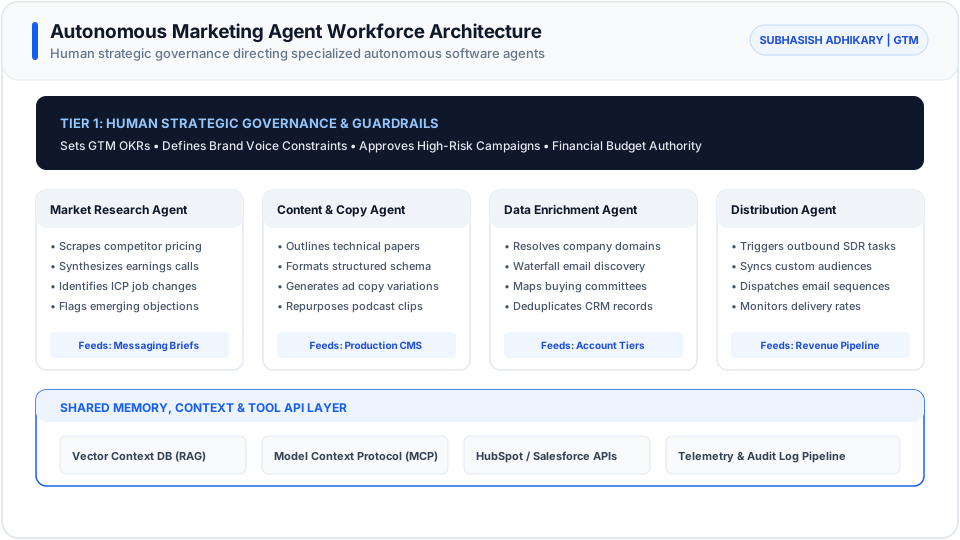
Establish communication protocols: How do agents communicate with humans and with each other? What information do they share? What format do they use? Clear protocols prevent confusion and duplication.
Set performance expectations: Agents should have clear performance metrics, just like humans. What are they optimizing for? How is success measured? What happens when they underperform?
Build feedback loops: Agents learn from outcomes. Build feedback loops that connect agent actions to results. When an agent makes a decision, track the outcome and feed it back to the agent for learning.
Managing Agent Performance
Managing agents is different from managing humans, but the principles are similar:
Monitor continuously: Agents operate at machine speed. Monitor their actions continuously, not just in weekly reviews. Catch errors before they compound.
Intervene when necessary: Agents will make mistakes. Define clear escalation paths for when human intervention is required. Do not let agents operate unsupervised in high-stakes situations.
Iterate on objectives: Agent objectives should evolve as the business evolves. Review and update objectives regularly. Ensure agents are optimizing for current priorities, not outdated goals.
Maintain human oversight: Despite their capabilities, agents require human oversight. Humans provide strategic direction, ethical judgment, and creative insight that agents cannot replicate.
The Future of Human-Agent Teams
The future of marketing is human-agent teams. Humans provide strategy, creativity, and judgment. Agents provide speed, scale, and optimization. Together, they achieve more than either could alone.
According to Gartner, companies using marketing agents report 45% reduction in manual tasks. But the value is not just efficiency - it is capability. Agents enable humans to focus on higher-value work while agents handle execution and optimization.
The challenge: 40% of agentic AI projects will fail due to poor implementation, according to Gartner. Success requires more than just deploying agents. It requires thoughtful integration, clear governance, and continuous improvement.
The organizations that master human-agent collaboration will define the next era of marketing. Those that do not will struggle to compete.