
Key Thesis
AI search is reshaping how buyers find information. Generative Engine Optimization (GEO) and Answer Engine Optimization (AEO) are becoming critical marketing disciplines.
The AI Search Landscape
Search is changing fundamentally. Google AI Overviews, ChatGPT Search, Perplexity, and other AI-powered search tools are reshaping how buyers find information. The implications for marketers are profound.
According to Similarweb research from July 2025, zero-click searches on Google grew from 56% to 69% in a single year following AI Overviews rollout. Users are getting answers directly from AI without clicking through to websites.
Meanwhile, Jasper research found that AI Overviews reduced click-through rates for top-ranking Google content by 58%, a significant jump from 34.5% the previous year. The traffic model that sustained content marketing for two decades is breaking down.
According to eMarketer, nearly a third (31.3%) of the US population will use generative AI search in 2026. Media Copilot reports that traffic from generative AI platforms grew 796% year over year into 2025, across an analysis of 2.3 billion sessions.
What Is Generative Engine Optimization?
Generative Engine Optimization (GEO) is the practice of optimizing content for visibility in AI-generated answers. Unlike traditional SEO, which optimizes for search engine rankings, GEO optimizes for citation in AI-generated responses.
When a user asks ChatGPT "What is the best marketing automation platform for B2B?", the AI generates an answer based on its training data and real-time search. GEO ensures your brand, your content, and your expertise appear in that answer.
Answer Engine Optimization (AEO) is a related discipline focused on optimizing for direct answers in featured snippets, voice search, and AI assistants. AEO and GEO overlap significantly but have different emphases.
GEO vs Traditional SEO
GEO and traditional SEO share foundations but differ in important ways:
Shared Foundations: Both require high-quality, authoritative content. Both benefit from technical SEO best practices. Both require understanding user intent.
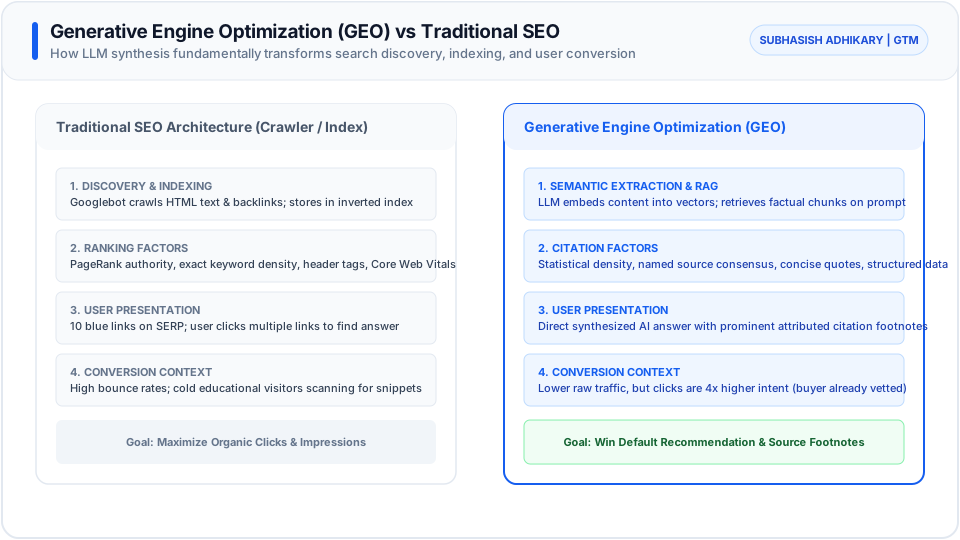
Key Differences:
- SEO optimizes for rankings. GEO optimizes for citations.
- SEO focuses on keywords. GEO focuses on entities and topics.
- SEO measures rankings and traffic. GEO measures citation frequency and brand mentions in AI answers.
- SEO relies on backlinks. GEO relies on content authority, entity recognition, and structured data.
According to Writer.com research, GEO is 80% strategic (positioning, authority) and only 20% technical. The technical optimizations matter, but the strategic foundation is what determines whether AI systems cite your content.
Implementing GEO Strategy
Implementing GEO requires several strategic pillars:
1. Entity Clarity: AI systems understand entities - people, organizations, products, concepts. Ensure your brand, products, and key people are clearly defined entities with consistent information across the web.
2. Content Authority: AI systems cite authoritative sources. Build topical authority through comprehensive, well-researched content. Publish original research, data, and analysis that AI systems cannot generate themselves.
3. Structured Data: Use schema markup to help AI systems understand your content. Implement Article, Organization, Person, Product, and FAQ schema where appropriate.
4. Citation Optimization: Include clear, quotable statements in your content. AI systems look for concise, authoritative statements they can cite. Structure content with clear headings, definitions, and key takeaways.
5. Brand Mentions: Ensure your brand is mentioned across authoritative sources. AI systems learn from the broader web, not just your website. Build brand presence through PR, partnerships, and community engagement.
Measuring AI Search Visibility
Measuring GEO is different from measuring SEO:
- Citation tracking: Monitor how often your brand and content are cited in AI-generated answers. Tools like Profound, Otterly, and manual monitoring can track this.
- Brand mention tracking: Monitor brand mentions across AI platforms. Are you being recommended? In what context?
- AI search traffic: Track traffic from AI search platforms. Use UTM parameters and referrer data to identify AI-sourced traffic.
- Zero-click impact: Monitor changes in traditional search traffic as AI search grows. Understand the relationship between AI visibility and traditional search performance.
The key insight: GEO is not about replacing SEO. It is about complementing it. As AI search grows, brands that optimize for both traditional and AI search will have a structural advantage.