
Key Thesis
Most companies measure marketing automation wrong. They track activity metrics instead of business outcomes. Here is how to measure what actually matters.
The Measurement Problem
Most marketing organizations measure automation by activity: emails sent, workflows built, leads nurtured. These are output metrics, not outcome metrics. They tell you what marketing did, not what it achieved.
The result: marketing can demonstrate high activity while struggling to demonstrate business impact. Leadership sees the cost of automation tools but not the return. The question "Is our automation investment worth it?" goes unanswered.
According to Nucleus Research, average marketing automation ROI is 4.2x when properly measured. But "properly measured" is the key phrase. Most companies do not measure properly.
An Outcome-Based Framework
Outcome-based measurement focuses on business results, not marketing activity. The framework has three levels:
Level 1: Pipeline Impact. How does automation affect pipeline generation, velocity, and quality? This is the most direct measure of automation value.
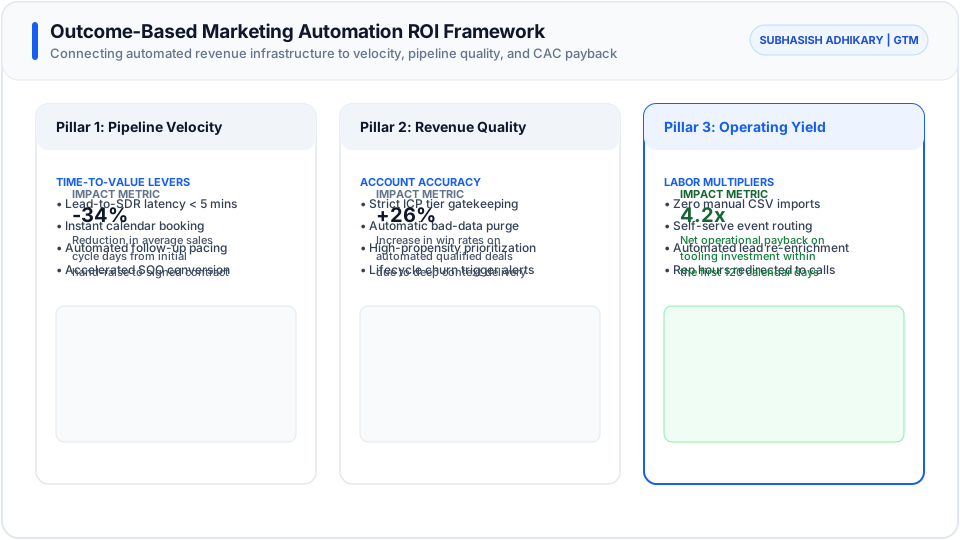
Level 2: Efficiency Gains. How does automation reduce costs, save time, and improve productivity? This measures operational value.
Level 3: Strategic Value. How does automation enable capabilities that were not possible before? This measures transformational value.
Measuring Pipeline Impact
Pipeline impact is measured across three dimensions:
Pipeline Generation: How much pipeline can be attributed to automated nurture? Track leads that entered automation workflows and converted to opportunities. Compare conversion rates of nurtured vs non-nurtured leads.
Pipeline Velocity: How quickly do nurtured leads move through the pipeline? According to industry benchmarks, lifecycle automation reduces sales cycle length by an average of 18%. Measure time from first touch to close for nurtured vs non-nurtured leads.
Pipeline Quality: Are nurtured leads higher quality? Measure win rates, deal sizes, and customer lifetime value for leads that went through automation vs those that did not.
According to research from the Demand Generation Association, companies measuring automation by business outcomes see 3x higher ROI than those measuring activity. The difference is not in the automation itself, but in how it is measured and optimized.
Measuring Efficiency Gains
Efficiency gains are measured by comparing pre-automation and post-automation performance:
Time Savings: How many hours of manual work does automation eliminate? Calculate the fully loaded cost of those hours (salary, benefits, overhead). This is direct cost savings.
Productivity Gains: How much more output does the team produce with automation? Measure campaigns per month, content pieces per quarter, or leads processed per week. Compare before and after.
Error Reduction: How many errors does automation prevent? Manual processes have error rates of 1-4%. Automation reduces this to near zero. Calculate the cost of errors (rework, customer complaints, lost opportunities) and compare.
Implementing Outcome Measurement
Implementing outcome-based measurement requires several foundations:
Baseline Measurement: Measure current performance before automation implementation. Without a baseline, you cannot measure improvement. Document pipeline generation, velocity, quality, and efficiency metrics.
Attribution Framework: Define how you will attribute outcomes to automation. Use controlled experiments where possible. Use baseline comparisons where experiments are not feasible.
Continuous Tracking: Track outcomes continuously, not just at implementation. Automation impact evolves over time as workflows are optimized and expanded.
Business Alignment: Ensure measurement aligns with business priorities. If the business cares about pipeline velocity, measure pipeline velocity. If it cares about cost reduction, measure cost reduction. Align measurement with what leadership values.
The key insight: marketing automation ROI is real, but only if measured properly. Companies that measure outcomes, not activity, demonstrate 3x higher ROI and secure continued investment in automation capabilities.