
Key Thesis
Most companies cannot measure the ROI of their AI marketing investments. This framework provides a structured approach to quantifying AI value across the marketing organization.
The Measurement Challenge
Most companies cannot accurately measure the ROI of their AI marketing investments. According to McKinsey 2024 research, only 23% of companies can quantify AI marketing ROI with confidence. The rest are investing based on intuition, not evidence.
The challenge is fundamental. AI marketing creates value in multiple ways - some direct, some indirect, some strategic. Traditional ROI measurement, which focuses on direct, short-term returns, cannot capture the full value.
Companies with mature AI measurement see 2.5x higher AI adoption rates, according to industry research. The ability to measure ROI is not just about justification - it is about acceleration. When you can measure value, you can invest more confidently.
An ROI Framework
AI marketing ROI should be measured across three dimensions:
1. Direct ROI: Measurable cost savings and revenue increases directly attributable to AI. This is the easiest to measure but often the smallest component of total value.
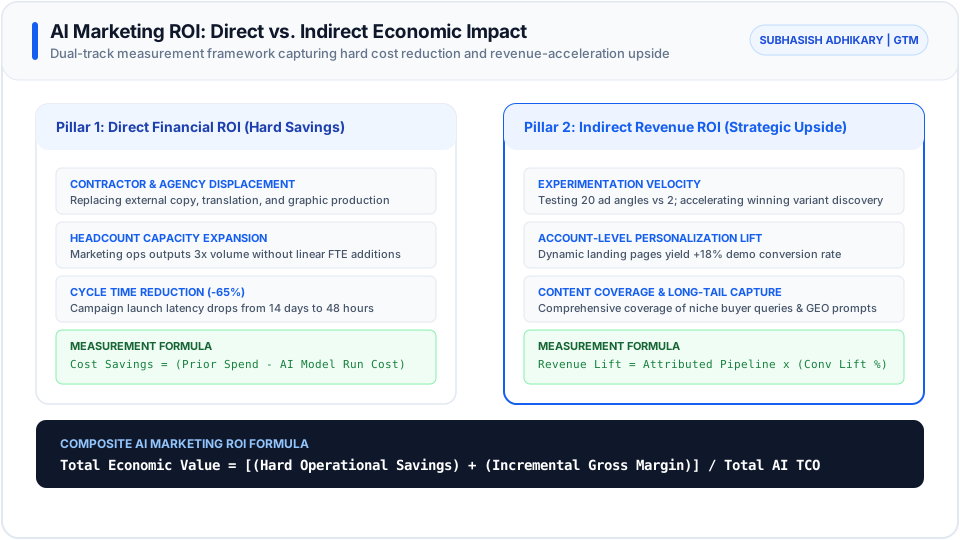
2. Indirect ROI: Capability improvements that enable better outcomes. AI enables faster iteration, better personalization, and more sophisticated optimization. These capabilities create value that is real but harder to attribute directly.
3. Strategic ROI: Competitive advantages and structural benefits that compound over time. AI-native organizations develop capabilities that are difficult to replicate. This strategic value is the largest but hardest to measure.
Measuring Direct ROI
Direct ROI is the most straightforward to measure:
Cost Savings: AI reduces manual work. Measure hours saved, FTEs reallocated, and costs avoided. If AI automates 1,000 hours of manual work per month at $50/hour, that is $50,000/month in cost savings.
Revenue Increases: AI improves conversion rates, increases deal size, and accelerates sales cycles. Measure the revenue impact of AI-optimized campaigns, AI-scored leads, and AI-personalized experiences.
Efficiency Gains: AI enables faster iteration, better targeting, and more sophisticated optimization. Measure improvements in campaign performance, lead quality, and customer lifetime value.
The formula is simple: (Revenue Increase + Cost Savings) - AI Investment = Direct ROI. But this captures only part of the value.
Measuring Indirect ROI
Indirect ROI is harder to measure but equally important:
Capability Improvements: AI enables capabilities that were not possible before. Personalization at scale, real-time optimization, predictive analytics. Measure the performance of AI-enabled capabilities vs pre-AI baseline.
Speed Improvements: AI accelerates iteration cycles. Measure time-to-insight, time-to-optimization, and time-to-decision. Faster iteration compounds over time.
Quality Improvements: AI improves decision quality. Measure improvements in forecast accuracy, lead quality, and campaign performance. Better decisions create value even when the direct financial impact is not immediately visible.
The challenge is attribution. How much of the improvement is due to AI vs other factors? Use controlled experiments, A/B testing, and baseline comparisons to isolate AI impact.
Implementing AI ROI Measurement
Implementing AI ROI measurement requires several foundations:
Baseline Measurement: Measure performance before AI implementation. Without a baseline, you cannot measure improvement. Document current state across all relevant metrics.
Attribution Framework: Define how you will attribute value to AI. Use controlled experiments where possible. Use baseline comparisons where experiments are not feasible. Be transparent about methodology and limitations.
Continuous Measurement: AI ROI is not a one-time calculation. Measure continuously as AI capabilities evolve and expand. Track both direct and indirect value creation.
Strategic Assessment: Beyond financial ROI, assess strategic value. Is AI creating competitive advantages? Building capabilities that compound? Enabling new business models? Strategic value may not show up in financial metrics for years.
According to industry benchmarks, AI marketing investments typically show ROI within 6-12 months when properly measured. But the full strategic value may take years to materialize. Measurement should capture both short-term returns and long-term strategic value.