
Key Thesis
B2B buyers are using AI to research, evaluate, and make decisions. Your GTM motion needs to adapt to buyers who are more informed, more efficient, and less dependent on sales.
The AI-Assisted Buying Reality
B2B buying is changing. Buyers are using AI tools - ChatGPT, Claude, Gemini, and specialized B2B research tools - to research solutions, evaluate vendors, and make decisions. According to Salesforce 2024 research, 67% of B2B buyers now use AI tools during the buying process.
This is not a future trend. It is happening now. And it is fundamentally changing the dynamics of B2B buying.
AI-assisted buyers are more informed. They can research your product, your competitors, and your market faster than ever before. They come to sales calls already educated. They ask more sophisticated questions. They have less patience for basic discovery.
AI-assisted buyers are more efficient. They can evaluate multiple vendors in parallel, comparing features, pricing, and reviews without waiting for sales decks. They compress what used to be a months-long evaluation into weeks.
AI-assisted buyers are less dependent on sales. They can find answers to most questions without talking to a human. The sales rep who used to be the primary source of information is now a nice-to-have, not a must-have.
How B2B Buyers Use AI
Based on interviews with B2B buyers and analysis of buying behavior, here is how AI is being used in the buying process:
Research and Education: Buyers use AI to understand their problem space, learn about potential solutions, and identify vendors. They ask questions like "What are the best project management tools for distributed teams?" or "How do I evaluate marketing automation platforms?"
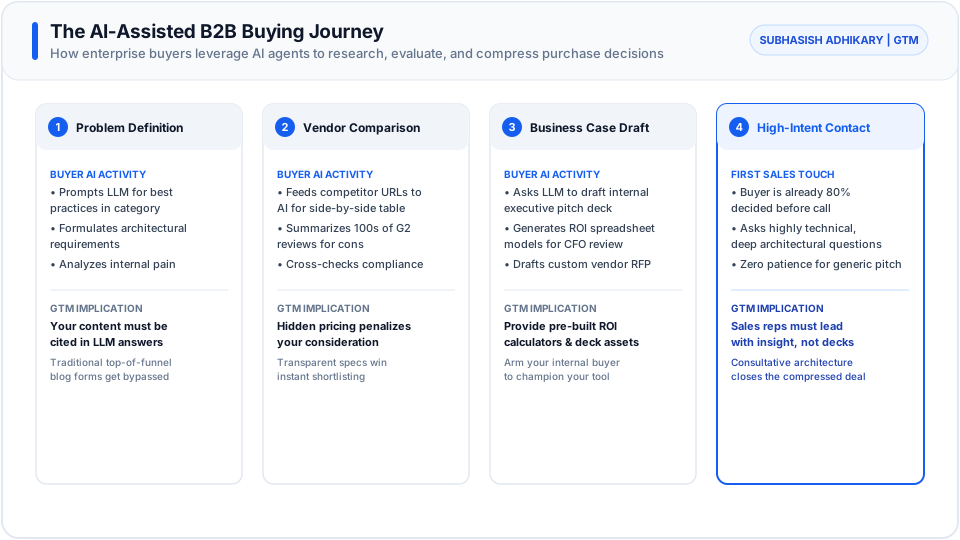
Vendor Evaluation: Buyers use AI to compare vendors, analyze reviews, and summarize product documentation. They ask questions like "Compare HubSpot vs Marketo for mid-market B2B" or "What are the pros and cons of Salesforce for startups?"
Decision Support: Buyers use AI to build business cases, create comparison matrices, and draft RFPs. They ask questions like "Help me build a business case for a new CRM" or "Create a vendor evaluation scorecard for marketing automation."
Implementation Planning: Buyers use AI to plan implementation, identify risks, and create project plans. They ask questions like "What are the common implementation challenges for marketing automation?" or "Create a 90-day implementation plan for a new CRM."
GTM Implications
AI-assisted buying has several implications for your GTM motion:
Content must be AI-comprehensible. If your content is not structured in a way that AI can parse and summarize, AI-assisted buyers will not find it. This means clear headings, structured data, and direct answers to common questions.
Sales must add value beyond information. If buyers can find information on their own, sales must provide something AI cannot: strategic advice, custom solutions, and relationship building. The sales rep who just presents a deck is obsolete.
Pricing must be transparent. AI-assisted buyers can easily compare pricing across vendors. If your pricing is hidden or complex, you will lose to competitors who are transparent.
Reviews and social proof matter more. AI-assisted buyers rely heavily on reviews and social proof. They ask AI to summarize G2 reviews, compare customer testimonials, and identify common complaints. Your reputation is more visible than ever.
Adapting Content for AI-Assisted Buyers
To serve AI-assisted buyers, your content needs to be:
Structured for AI comprehension. Use clear headings, bullet points, and tables. AI models parse structured content more effectively than dense prose. Answer common questions directly in the content.
Comprehensive and authoritative. AI-assisted buyers are looking for definitive resources. Thin content will not satisfy them. Create comprehensive guides that cover the topic thoroughly.
Optimized for AI search. AI-assisted buyers are using AI search tools (ChatGPT, Perplexity, Google AI Overviews) to find information. Optimize your content for these tools, not just traditional search engines.
Rich in structured data. Include comparison tables, feature matrices, pricing information, and implementation timelines. AI can parse and summarize this data more effectively than prose.
Adapting Sales for AI-Assisted Buyers
Sales teams need to adapt to AI-assisted buyers by:
Leading with insight, not information. AI-assisted buyers already have the information. Sales should lead with strategic insight, custom analysis, and unique perspectives that AI cannot provide.
Respecting buyer intelligence. Do not treat AI-assisted buyers as if they are uninformed. They have done their research. Acknowledge their knowledge and build on it.
Providing custom solutions. AI can provide generic advice. Sales should provide custom solutions tailored to the buyer specific situation, challenges, and goals.
Building relationships. AI cannot build relationships. Sales should focus on building trust, understanding the buyer needs, and becoming a trusted advisor rather than just a vendor.