
Key Thesis
Personalization is not just about using someone's first name in an email. True lifecycle personalization adapts every touchpoint based on where the customer is in their journey.
The Reality of Personalization
Most B2B personalization is superficial. It uses the prospect's first name in an email. It segments by industry or company size. It is personalization in name only.
True personalization adapts every touchpoint based on where the customer is in their journey, what they have done, what they need, and what will move them forward. It is not about using variables in templates. It is about delivering the right message, to the right person, at the right time, through the right channel.
According to Salesforce 2024 research, 80% of consumers are more likely to buy from companies that offer personalized experiences. The expectation is set. The question is whether B2B companies can deliver.
Defining Lifecycle Stages
Lifecycle personalization starts with clear stage definitions. Every customer exists in exactly one stage at any given time. Stages should be mutually exclusive and collectively exhaustive.
A typical B2B lifecycle might include:
- Awareness: The prospect is learning about your category and potential solutions.
- Consideration: The prospect is evaluating specific solutions, including yours.
- Decision: The prospect is making a purchase decision.
- Onboarding: The customer is implementing your solution.
- Adoption: The customer is using your solution and realizing value.
- Expansion: The customer is expanding usage, adding users, or purchasing additional products.
- Advocacy: The customer is referring others and promoting your brand.
Each stage requires different messaging, different content, and different engagement strategies. Personalization means delivering the right experience for each stage.
A Personalization Framework
Here is a framework for lifecycle personalization:
1. Stage-Based Messaging: Each lifecycle stage has a core message. Awareness is about education. Consideration is about differentiation. Decision is about proof. Onboarding is about success. Adoption is about value. Expansion is about growth. Advocacy is about community.
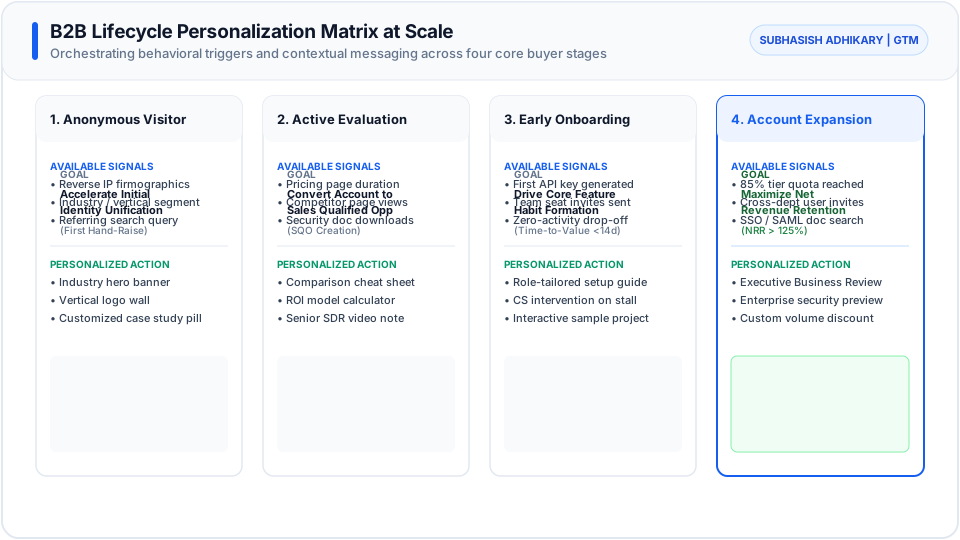
2. Behavioral Triggers: Define the behaviors that indicate stage transitions. When a prospect downloads a comparison guide, they are moving from awareness to consideration. When a customer completes onboarding, they are moving to adoption. Trigger the appropriate experience for each transition.
3. Channel Orchestration: Different stages require different channels. Awareness might use content marketing and SEO. Consideration might use email nurture and webinars. Decision might use sales outreach and demos. Onboarding might use in-app messaging and customer success. Orchestrate channels based on stage.
4. Content Mapping: Map content to each stage. Create content that serves the specific needs of each stage. Awareness content educates. Consideration content differentiates. Decision content proves. Onboarding content guides. Adoption content optimizes.
Implementation at Scale
Implementing lifecycle personalization at scale requires technology and process:
Technology: Use a marketing automation platform that supports lifecycle stages, behavioral triggers, and dynamic content. Ensure your CRM tracks stage transitions. Use a customer data platform to unify data across systems.
Process: Define stage transition criteria with sales and customer success. Build workflows for each transition. Create content for each stage. Test and iterate.
AI Enhancement: Use AI to enhance personalization. AI can predict stage transitions before they happen, recommend the best content for each individual, and optimize send times and channels. According to industry research, AI-powered personalization can handle 1000x more segments than manual approaches.
Measuring Personalization ROI
Measure lifecycle personalization by:
- Stage progression velocity: How quickly are customers moving through stages?
- Conversion rates by stage: Are stage-specific experiences improving conversion?
- Customer lifetime value: Is personalization increasing LTV?
- Retention rates: Is personalization improving retention?
According to industry benchmarks, lifecycle personalization increases customer lifetime value by 25-40%. Companies with mature personalization see 2-3x higher marketing ROI.