
Key Thesis
Marketing is evolving from a collection of tools to an integrated operating system powered by AI. The companies that build this architecture will have a structural advantage.
The Current State of Marketing Technology
The average B2B marketing organization uses 13 different tools, according to Chiefmartec's 2024 marketing technology landscape. CRM, marketing automation, analytics, content management, social media, advertising, email, SEO, ABM, attribution, and more.
The problem: these tools do not work together. Data silos persist. Workflows require manual handoffs. Insights are fragmented. The marketing team spends more time managing tools than executing strategy.
According to Salesforce 2024 research, only 29% of marketers say their martech stack is fully integrated. The rest are managing a collection of point solutions that require constant manual coordination.
What Is a Marketing Operating System?
A marketing operating system is not another tool. It is an architecture that unifies your existing tools into a coherent system. It provides a single data layer, a unified intelligence layer, and orchestrated execution across all channels.
Think of it like an operating system on your computer. The OS does not replace your applications - it provides the foundation that allows them to work together. Similarly, a marketing OS does not replace your CRM, automation platform, or analytics tools. It provides the foundation that allows them to work as a unified system.
Architecture of an AI Marketing OS
An AI marketing OS has four layers:
1. Data Layer: A unified data foundation that collects data from all sources - CRM, marketing automation, website analytics, product usage, advertising platforms, and more. This layer provides a single source of truth for all marketing data.
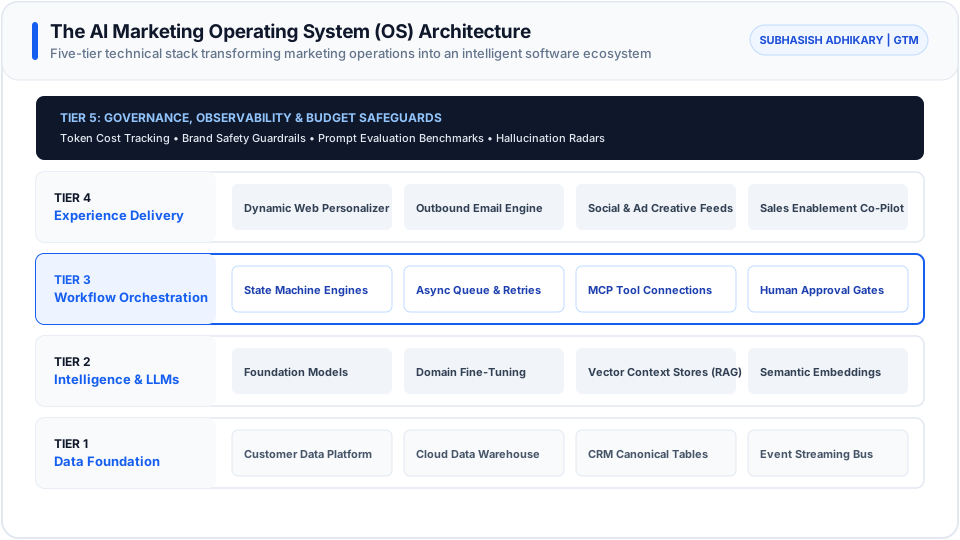
2. Intelligence Layer: AI models that analyze data, identify patterns, predict outcomes, and generate insights. This layer powers personalization, optimization, and decision support across the system.
3. Execution Layer: Orchestrated workflows that execute across channels based on intelligence. This layer coordinates email, ads, content, sales outreach, and customer success based on a unified strategy.
4. Measurement Layer: Unified analytics that measure performance across the entire system. This layer provides end-to-end visibility from awareness to retention.
Building Your Marketing OS
Building a marketing OS is a multi-phase initiative:
Phase 1: Data Unification. Connect all data sources into a unified data layer. Use a customer data platform (CDP) or integration layer like Segment. Ensure every touchpoint updates the unified customer view.
Phase 2: Intelligence Foundation. Build AI models for key use cases: lead scoring, content personalization, campaign optimization, and churn prediction. Start with simple models and iterate based on results.
Phase 3: Workflow Orchestration. Build orchestrated workflows that span channels. When a lead reaches a certain score, trigger email, notify sales, and launch retargeting ads - all coordinated by the OS.
Phase 4: Measurement and Optimization. Implement unified analytics that measure end-to-end performance. Use the data to continuously optimize the system.
The Future of Marketing Operations
The marketing OS is evolving toward full agentic operation. In the near future, marketing OS will not just orchestrate workflows - it will make strategic decisions. It will allocate budget, select channels, craft messaging, and optimize campaigns autonomously.
The role of the marketer will shift from executor to strategist. Marketers will define objectives, set guardrails, and provide strategic direction. The OS will handle execution, optimization, and iteration.
This is not science fiction. It is the direction the industry is heading. The question is not whether marketing will become AI-native, but when - and whether your organization will lead or follow.