
Key Thesis
Most marketing automation is built bottom-up, tactic by tactic. The winning approach is top-down: design the system first, then build the workflows.
The Bottom-Up Problem
Most marketing automation is built bottom-up. A marketer needs to solve an immediate problem, so they build a workflow. Then another problem arises, so they build another workflow. Over time, they accumulate dozens or hundreds of workflows with no overarching architecture.
The result: automation debt. Workflows overlap, contradict, and confuse. Leads receive conflicting messages. The team spends more time maintaining workflows than building strategy. According to Forrester, 60% of marketing automation implementations fail to meet expectations, largely due to this bottom-up approach.
The Systems Approach
The systems approach flips the script. Instead of building workflows to solve immediate problems, you design the system first, then build workflows that serve the system.
The system is defined by your customer lifecycle. Every lead exists in a stage. Every workflow serves a stage transition. Every message is appropriate for the stage. The system is coherent, scalable, and maintainable.
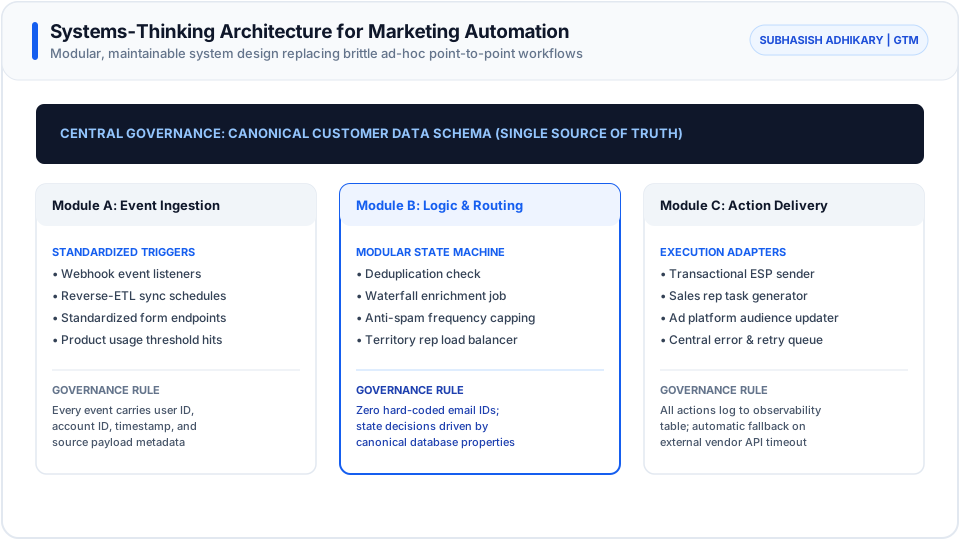
According to HubSpot research, companies with documented automation strategy see 40% higher revenue growth. The documentation is not bureaucracy - it is the blueprint that ensures coherence.
A Design Framework
Here is a framework for systems-based automation design:
Step 1: Define Lifecycle Stages. Map your customer journey from first touch to advocacy. Define clear stage boundaries. Ensure every lead exists in exactly one stage.
Step 2: Define Stage Transition Triggers. What behaviors indicate a stage transition? When does a lead move from awareness to consideration? From consideration to decision? From customer to advocate? Define these triggers clearly.
Step 3: Design Stage-Specific Experiences. For each stage, define the messaging, content, channels, and goals. What should a lead in this stage receive? What should they learn? What action should they take?
Step 4: Build Workflows That Serve the System. Build workflows that move leads through stages. Each workflow should have a clear purpose: move leads from stage A to stage B. Do not build workflows that exist outside the system.
Implementation Principles
When implementing lifecycle-based automation:
Start simple. Do not try to automate everything at once. Start with the most critical stage transitions. Build, measure, learn, and expand.
Test thoroughly. Automation errors can damage customer relationships. Test every workflow before deployment. Monitor closely after deployment.
Document everything. Every workflow should have documentation: purpose, triggers, actions, and expected outcomes. This ensures maintainability and enables team scaling.
Measure outcomes. Measure workflow performance by stage transition rates, not just open rates and click rates. The goal is progression, not just engagement.
Governance and Maintenance
Automation requires ongoing governance:
Workflow review process. No new workflow should be built without architectural review. Ensure it fits the system, does not duplicate existing workflows, and serves a clear purpose.
Regular audits. Audit workflows quarterly. Identify unused workflows, overlapping workflows, and underperforming workflows. Clean up regularly.
Performance monitoring. Monitor workflow performance continuously. Identify workflows that are not achieving their goals and iterate or retire them.
According to industry benchmarks, top-down automation design reduces workflow complexity by 50%. Lifecycle-based automation improves lead conversion by 35%. The systems approach is not just cleaner - it is more effective.